
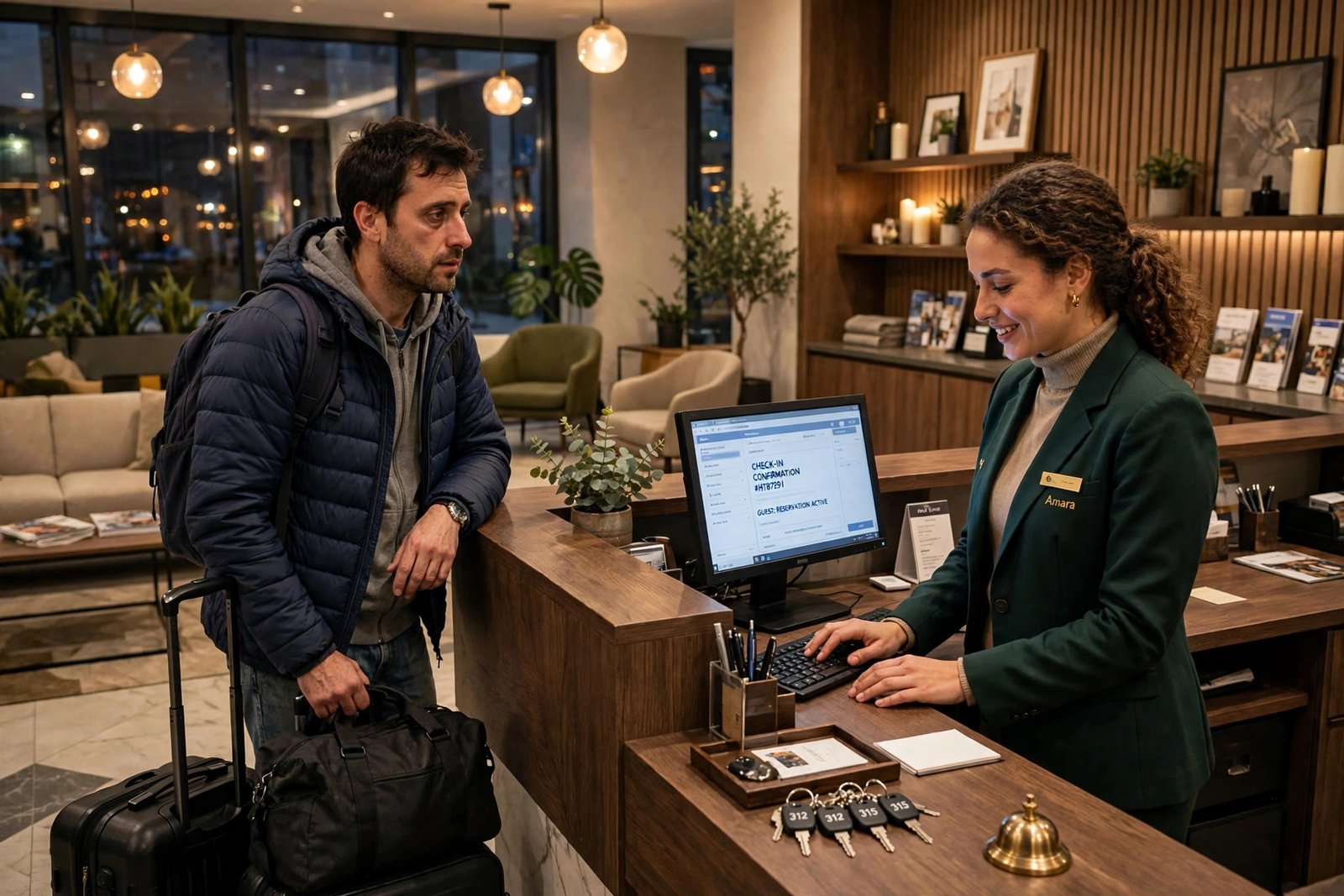
You step out of the taxi after a long flight, drag your suitcase through the lobby, and hand over your passport with a tired smile. The receptionist types, frowns, types again — and then says the words no traveler wants to hear: “I’m sorry, we don’t have a reservation under that name.” Your stomach drops. It is late, you are exhausted, and the room you paid for seems to have vanished. Before panic takes over, take a breath. A “lost” reservation is usually found within a few minutes, and even when it genuinely is gone, you have more options — and more rights — than the front desk may volunteer.
First, Take a Breath — It Is Usually Fixable
Most lost reservations are not lost at all. They are misfiled, misspelled, booked under a different name, or sitting in the system under the wrong date. A single wrong letter in a surname or a date read the wrong way around is enough to make your booking invisible to a quick search.
So do not accept “we have no record of you” as the final answer, and do not walk away to book somewhere else at your own expense. Stay at the desk, stay polite, and work through the checks below — calm guests get helped faster.
Check Your Own Confirmation Before You Argue
Open your booking confirmation on your phone and check four things:
- The confirmation number. This is the fastest way for staff to find you.
- The dates. Check them twice — month/day confusion is one of the most common causes of a “missing” reservation.
- The exact hotel name and address. Chains often have several properties in one city with near-identical names — you may be in the right brand but the wrong building.
- The name on the booking. If someone else made the reservation, it may be under their name, not yours.
Ask the Front Desk to Search Properly
Ask the receptionist — politely — to try each of these:
- Your confirmation number, typed in exactly as shown.
- Spelling variations of your name, including your first name only, or your surname with common misspellings.
- Your email address or phone number, which many systems can search by.
- The booking channel — the reservation may be filed under the booking site’s name rather than yours.
- Nearby dates — a booking starting tomorrow will not show in tonight’s arrivals.
If the agent gives up after one try, ask — again politely — to speak with the duty manager or to have them call central reservations. Managers have access to wider searches and can see bookings the front-desk system hides. This one request solves a surprising number of “lost” reservations.
Show Your Proof — Calmly and Clearly
Once you have the confirmation open, show it. A confirmation email or app screen with the hotel’s name, your dates, and a booking reference is hard to argue with, and it changes the conversation from “we can’t find you” to “here is the booking you need to honor.” If you prepaid, show the payment receipt too, and keep your ID ready — matching ID helps if the booking is under a slightly different name.
Note the time and the name of the person helping you — if this ends in a dispute, those notes matter.
If There Really Is No Room: Know What “Being Walked” Means
Sometimes the reservation is not misfiled — the hotel is simply full. Hotels deliberately sell more rooms than they have, betting some guests will cancel or not show up. When that bet fails, someone gets turned away — the industry word is being “walked.”
In the United States there is no federal law that spells out what a hotel owes a walked guest — your protection comes from the booking contract and the chain’s own policies. But the standard practice, followed by virtually every major brand, is that the hotel must:
- Find you a comparable or better room at a nearby property, not a downgrade across town.
- Pay for your first night at the replacement hotel.
- Cover your transport there — a taxi or rideshare, at no cost to you.
- Cover any rate difference if the replacement room costs more than the one you booked.
Use the word “walked” at the desk. It signals that you know the routine, and it points staff toward the walk policy they already have. Whatever is offered, get it in writing before you leave — the name of the replacement hotel, confirmation that the original hotel is paying for it, and any extra compensation promised. A printed note or an email from the manager is enough. Do not accept a vague promise of a refund “later” — your problem is a bed tonight.
For a fuller explanation of your rights when a hotel overbooks, this guide from LegalClarity is a clear, plain-English reference: Hotel Overbooked: What Are Your Rights?
If You Booked Through a Booking Site
If you booked through a platform like Booking.com or Expedia, call their support line too — while you are still at the desk if you can. They can pressure the hotel or rebook you themselves.
Do not let the hotel and the booking site bounce you back and forth. The hotel is the one that owes you the room, even when a third party took the booking. If the hotel tells you to “call Booking.com” and Booking.com tells you to “talk to the hotel,” stay put and ask the hotel manager to call the platform directly. That usually ends the loop.
If You Already Paid — Don’t Pay Twice
In the stress of the moment, many travelers pay for a new room themselves and sort it out later — and “later” never comes.
If you prepaid and the hotel cannot give you a room, you are entitled to a full refund, even if the booking was marked non-refundable — that label applies to cancellations you make, not to a room the hotel fails to provide.
Before you pay for anything else, get written confirmation of what the hotel will cover and keep every receipt. If a charge for a room you never slept in still appears on your card, contact your card issuer promptly to dispute it — your confirmation email and the hotel’s written note make that straightforward.
How to Stop This Happening Again
You cannot control overbooking, but you can make a lost reservation far less likely:
- Confirm 24 to 48 hours before arrival. A quick call or email to the hotel directly catches most errors while there is still time to fix them.
- Screenshot your confirmation. Emails get buried and apps need signal. A screenshot works offline at 2 a.m. in a foreign airport.
- Book direct when the price is close. Direct bookings are walked last, and the hotel can fix your booking without a middleman.
- Save the hotel’s direct number. If something goes wrong on the way, call the property itself, not a central call center.
- Check in online when offered, and arrive before any late check-in cutoff in your confirmation.
Frequently Asked Questions
Can a hotel turn me away if I have a confirmed reservation?
It happens, usually because of overbooking. But a confirmed reservation is a contract — if the hotel cannot provide your room, it should relocate you to a comparable one and cover the cost, not simply send you away.
Will I get a refund if the hotel overbooked and I already paid?
Yes. If the hotel cancels because it overbooked, you are entitled to a full refund of any deposit or prepayment, including on bookings marked non-refundable. Keep your confirmation and any written offer from the hotel as proof.
What if the replacement hotel is worse than the one I booked?
You do not have to accept a downgrade — the standard is a comparable or better room. If what is offered falls short, say so, ask for something equivalent, and document what was offered.
Final Thoughts
A lost hotel reservation feels like a disaster at midnight in a strange city, but it is almost always solvable — usually with a second search, sometimes with a free room down the street. Stay calm, show your confirmation, ask the desk to search properly, know what being walked means, and never pay twice for the same night.
Travel rarely goes exactly to plan — from a lost booking to the tourist traps to watch out for when traveling abroad. The travelers who cope best are the ones who know what to ask for before they need it. Now you do too.