
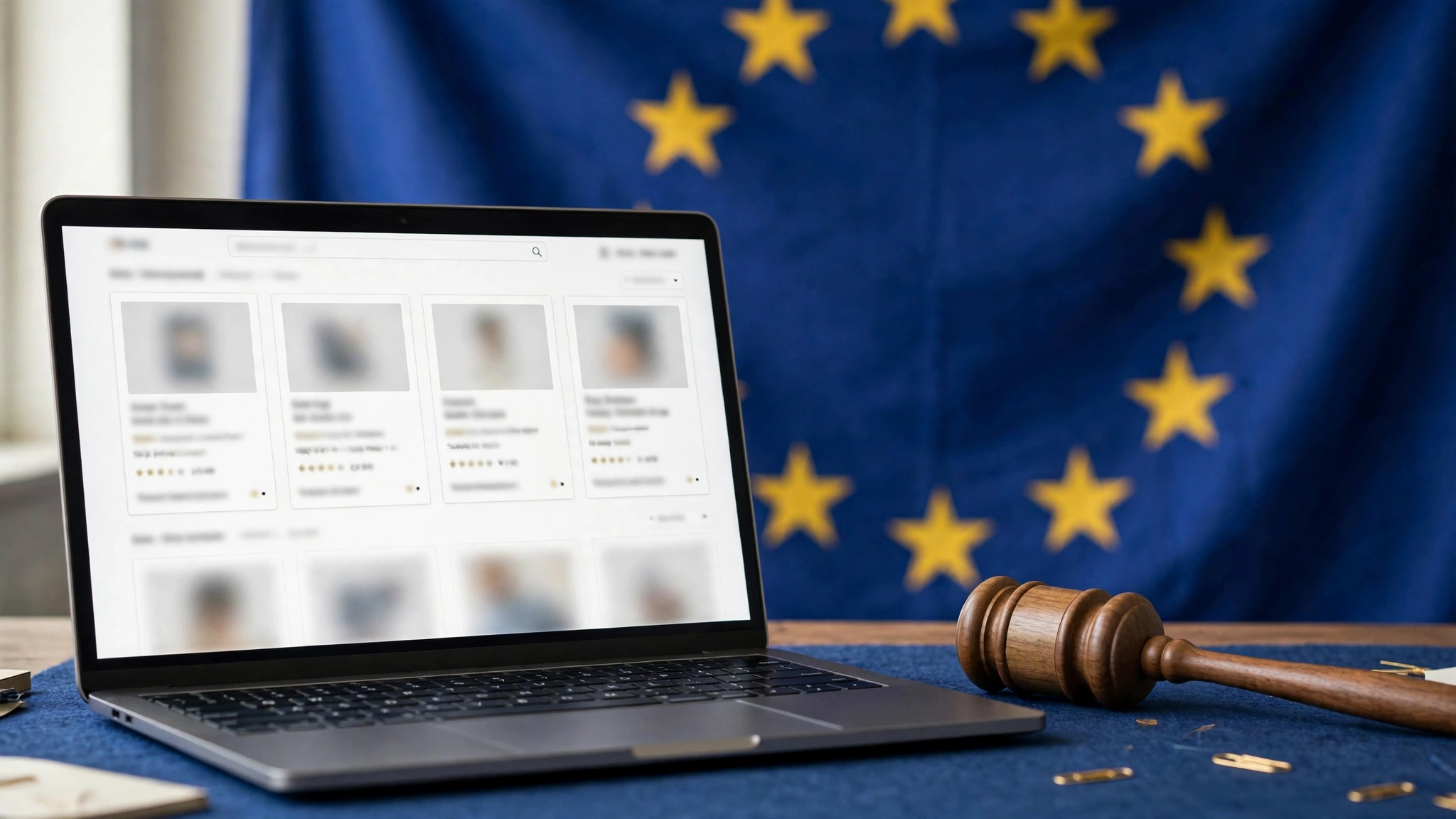
You search for a pair of running shoes. Before you see a single ordinary result, a neat row of product photos, prices and star ratings appears at the very top of the page — all of them from Google’s own shopping service. Rival sites offering the same shoes sit further down, in plain text links, where far fewer shoppers ever look. That small difference in placement was at the heart of one of the biggest antitrust cases in European history — and it ended with a fine of €2.42 billion.
This is the story of that fine: what Google did, why the European Commission punished it, how the case travelled through the courts for seven years, and why its final ruling in 2024 still shapes how big tech platforms are regulated today.
The Fine That Made Headlines
On 27 June 2017, the European Commission fined Google €2,424,495,000 for abusing its dominant position in online search. At the time, it was the largest antitrust fine the Commission had ever imposed on a single company — a record that held for just over a year.
The Commission, led on competition by Commissioner Margrethe Vestager, found that Google had broken EU competition law — Article 102 of the Treaty on the Functioning of the European Union, which prohibits a dominant company from abusing its market power. The abuse, in the Commission’s view, was not that Google was big. Being dominant is not illegal under EU law. The problem was what Google did with that dominance: it used its search engine to give its own comparison shopping service an advantage its rivals could not match.
The case covered Google’s conduct in 13 countries of the European Economic Area, over a period running from 2008 to 2017.
What Google Was Accused of Doing
A comparison shopping service lets you search for a product and compare prices from different sellers in one place. In the 2000s, independent services such as Foundem, Kelkoo and others built their businesses on appearing in Google’s search results, where shoppers would find them.
According to the Commission’s decision, Google changed the rules of that game in two ways:
- Its own service got the best spot. Results from Google’s comparison shopping service were placed in prominent boxes at the top of the general search results page, complete with pictures, prices and ratings — the eye-catching format shoppers notice first.
- Rivals were pushed down. Competing comparison shopping services appeared only as plain, generic text links, and the Commission found they were demoted in the rankings by Google’s search algorithms.
The effect, the Commission concluded, was that rival services lost visibility and traffic, while Google’s own service gained it. Shoppers were not necessarily seeing the best or cheapest options first — they were seeing Google’s options first. That practice has a name in competition law: self-preferencing, when a dominant platform gives its own services better treatment than those of its competitors.
The investigation had begun years earlier, in 2010, after complaints from rival comparison shopping services. By the time the decision arrived in 2017, the case had already run for seven years.
Why the Fine Was €2.42 Billion
EU antitrust fines are not picked out of thin air. They reflect how serious the infringement was, how long it lasted, and the size of the company involved. When the courts later reviewed the amount, they found it appropriate given the gravity and duration of the conduct and Google’s significant overall turnover.
The figure was deliberately large. Competition fines are meant to do two things: punish the behaviour and deter other dominant companies from doing the same. A small fine against a company of Google’s size would have done neither. Alphabet, Google’s parent company, was held jointly liable for €523,518,000 of the total.
It is worth noting what the fine was not. It was not compensation for shoppers or for the rival services that lost traffic. Fines imposed by the Commission go to the EU budget. The remedy for consumers was supposed to be structural: a search market in which rival services could compete on equal terms.
The Long Road Through the Courts
Google and Alphabet appealed, and the case spent another seven years in the EU courts.
First, the General Court — the EU’s lower court — examined the Commission’s decision in full. On 10 November 2021, it upheld the decision and the fine, confirming that Google’s favouring of its own service was an abuse of its dominant position. Google appealed again, this time to the Court of Justice of the European Union, the EU’s highest court.
On 10 September 2024, in case C-48/22 P, the Court of Justice dismissed Google and Alphabet’s appeal in its entirety and upheld the fine of €2.4 billion. The judgment is final — there is no further appeal. As the Court’s press release put it, the Court upheld the fine imposed on Google for abuse of its dominant position by favouring its own comparison shopping service. You can read the Court’s own summary of the ruling in its press release 135/24.
Fourteen years after the first complaints, the Google Shopping saga was over. The fine stood exactly as imposed in 2017.
What Changed for Shoppers
The Commission’s decision did more than impose a fine. It ordered Google to stop the favouring and to give rival comparison shopping services the same treatment as its own service in its search results.
Google responded by changing how its shopping units work in Europe. Rival comparison shopping services can now compete for space in the prominent shopping boxes on the same terms as Google’s own service, rather than being confined to plain links further down the page. Whether that restored genuine competition is still debated among competition lawyers and the rival services themselves, but the principle was established: a dominant search engine cannot use its front page as a shop window for its own products alone.
Why the Case Still Matters
The Google Shopping decision became the template for how Europe deals with Big Tech. Three reasons stand out.
Self-preferencing became a recognised abuse. Before this case, it was not settled that a platform favouring its own services could count as an abuse of dominance. The courts confirmed that it can, when the platform is dominant and the favouring is discriminatory. That reasoning now shapes cases and rules across the tech sector.
It opened the door to bigger penalties. The Shopping fine was a record in 2017 — but only briefly. In 2018, the Commission fined Google €4.34 billion in a separate case about its Android mobile operating system, a larger penalty built on the same enforcement approach. The Shopping case showed that the Commission was willing to fine the world’s biggest tech companies at a scale that matched their size.
It led to new rules. The EU’s Digital Markets Act, which began applying in 2023, now bans self-preferencing outright for the largest designated platforms. Instead of proving abuse case by case over many years, regulators can now enforce a clear rule. The Google Shopping case is widely seen as one of the cases that made that law necessary.
Legal cases like this one turn on how courts interpret competition rules and what remedies actually change behaviour — the same questions that sit at the centre of our guide to the Texas legal framework, which explains how a legal system shapes the way businesses operate.
Frequently Asked Questions
How much was Google fined over its Shopping service?
€2,424,495,000 — about €2.42 billion. The European Commission imposed the fine on 27 June 2017, and it was upheld in full by the EU’s highest court on 10 September 2024.
Is the fine final, or can Google still appeal?
It is final. The Court of Justice dismissed Google and Alphabet’s appeal in case C-48/22 P, and there is no further appeal from that court.
Was it the biggest EU antitrust fine ever?
It was a record when imposed in 2017, but it no longer holds that title. In 2018, the EU fined Google €4.34 billion in the Android case, which remains the larger penalty.
What is self-preferencing?
Self-preferencing is when a dominant platform gives its own products or services better placement, visibility or treatment than those of its competitors on the same platform — for example, showing its own shopping results in a prominent box at the top of the page while rivals appear only as plain links.
Did shoppers receive any money from the fine?
No. Fines imposed by the European Commission go to the EU budget. The intended benefit for shoppers was more choice and fairer competition in search results, not a payment.
Final Thoughts
The Google Shopping fine began with a simple observation: when you search for a product, the results you see first are not always the best ones — sometimes they are simply the platform’s own. The EU spent fourteen years, from the first complaints to the final court ruling, establishing that a dominant search engine cannot tilt its own front page in its own favour.
For shoppers, the case is a reminder to look past the first box of results. For the tech industry, it was the moment European competition law showed it could reach the biggest companies in the world — and that its rulings, once made, would survive every appeal.